
How Fast Are Mobile X Ray Results for Maryland Families Mobile Digital X Ray Service
When someone at home may have a fracture, pneumonia concern, hip pain, or a sudden change after a fall, waiting for answers can feel stressful. The good news is that mobile X-ray results are often available much faster than many families expect, especially when the exam is ordered clearly and the patient is easy to reach.
For many mobile X-ray services, the imaging appointment can often happen the same day or next day, depending on availability, location, and medical urgency. After the images are taken, results are commonly sent to the ordering provider within a few hours to 24 hours. Urgent findings may be communicated faster.
That said, turnaround time is not the same for every case. The speed depends on scheduling, travel distance, the type of exam, mobile equipment access, and how quickly a radiologist can review the images.
This guide explains what Maryland families can usually expect, what can slow things down, and why mobile X-ray care can be such a practical option for people who should not have to make a difficult trip to an imaging center or emergency department.

Most mobile X-ray results are measured in hours, not days
Mobile X-ray speed has two parts. First, the service needs to schedule and complete the exam. Second, the images must be reviewed and reported.
In a typical non-emergency situation, families may see a timeline like this:
Step | Typical timing | What happens |
Order is placed | Same day | A doctor, nurse practitioner, or other authorized clinician requests the exam |
Appointment is scheduled | Same day or next day | The mobile team confirms location, patient details, and exam type |
X-ray is performed | Often 15 to 30 minutes on site | The technologist positions the patient and captures the images |
Images are sent for review | Soon after the exam | Digital images are transmitted for radiology review |
Report is returned | Often within hours to 24 hours | The ordering provider receives the official interpretation |
For urgent cases, some mobile imaging companies may prioritize the visit or escalate the report. For routine cases, the timeline may be longer, especially during peak demand or if the request comes in late in the day.
The key point is simple: mobile X-ray results are usually not a long, open-ended wait. Digital imaging allows images to move quickly from the home or care setting to the radiology team.
Still, families should remember that the mobile X-ray company usually does not replace the clinician who ordered the test. The radiologist interprets the images, then the ordering provider explains what the results mean and what to do next.
This article is for general information only. It does not replace medical advice, diagnosis, or treatment from a licensed healthcare professional.
Why quick results matter for Maryland families
Fast X-ray results do more than reduce worry. They can change what happens next.
For a child with a suspected wrist fracture, results can help a clinician decide whether splinting, orthopedic follow-up, or emergency care is needed. For an older adult with hip pain after a fall, imaging can help determine whether it is safe to stay home or whether a higher level of care is needed. For someone with breathing symptoms, a chest X-ray may help a provider decide the next step in treatment.
Quick answers can be especially helpful when travel is hard. In Maryland, a trip to an imaging center may involve more than the drive itself. Families may need to arrange wheelchair transport, take time off work, manage stairs, deal with weather, or coordinate care for a loved one with dementia, limited mobility, or severe pain.
Mobile imaging reduces that burden. The exam comes to the patient, which can help avoid:
Long waits in busy waiting rooms
Difficult transfers in and out of a car
Extra discomfort for someone in pain
Exposure to crowded healthcare settings
Stress for caregivers coordinating transportation
Fast results also help families plan. Even when the result is reassuring, having an answer can make it easier to decide whether to continue home care, call the doctor again, schedule follow-up, or seek urgent treatment.
A fast X-ray report can turn uncertainty into a clear next step.
How mobile X-ray services work
A mobile X-ray visit is designed to be efficient, but there is a clear process behind it.
A clinician orders the exam
Most mobile X-ray services require an order from a qualified healthcare provider. This order tells the imaging team what body part needs imaging and why. For example, the order may request a chest X-ray, ankle X-ray, shoulder X-ray, spine X-ray, or hip X-ray.
A complete order helps the mobile team move faster. It should include the patient’s information, location, requested exam, clinical concern, and contact information for the ordering provider.
The mobile team schedules the visit
After the order is received, the service confirms details and schedules the appointment. The team may ask about stairs, parking, patient mobility, oxygen use, room layout, or whether the patient can sit, stand, or lie down.
These questions are not just administrative. They help the technologist arrive prepared and complete the exam safely.
A technologist brings the equipment to the patient
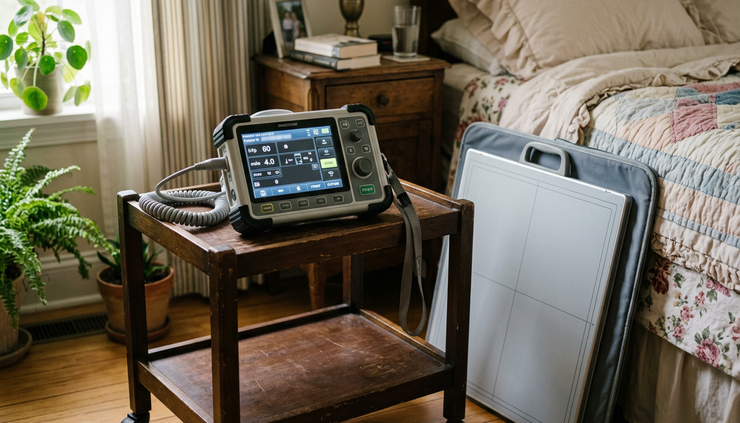
The technologist arrives with portable digital X-ray equipment. Depending on the exam, the patient may stay in a bed, sit in a chair, or stand briefly. The technologist positions the equipment and captures the needed images.
Most X-ray exams are quick. The positioning may take longer than the actual exposure. The technologist may take more than one image so the radiologist can see the area from different angles.
Images are sent for interpretation
Once the images are captured, they are transmitted digitally for review. A radiologist interprets the images and prepares a report. The report is then sent to the ordering provider.
In some cases, the provider may receive a call about a critical or urgent finding. Routine findings are usually shared through the standard reporting process.
The ordering provider explains the result
The official report uses medical language. The ordering clinician puts that report into context. They may compare it with symptoms, medical history, exam findings, prior imaging, and lab results.
That is why families should ask the ordering provider when and how results will be shared. Some offices call only for abnormal results. Others send reports through a patient portal. Some follow up by phone.
What affects the speed of mobile X-ray results
Turnaround time can vary for understandable reasons. Knowing the common factors can help families set realistic expectations.
Medical urgency
A suspected serious injury or concerning chest finding may be prioritized over a routine follow-up image. When placing the order, the clinician should clearly state the reason for the exam and whether the case is urgent.
If symptoms are severe, such as chest pain, trouble breathing, sudden weakness, major trauma, or uncontrolled pain, families should not wait for mobile imaging. Call 911 or seek emergency care.
Time of day
Orders placed early in the day may be easier to schedule quickly. Requests placed late afternoon, in the evening, or near a weekend may take longer, depending on staffing and coverage.
That does not mean same-day care is impossible. It means the service may need to balance travel routes, urgent cases, and radiology availability.
Location and travel distance
Maryland includes dense areas, suburbs, smaller towns, and rural communities. Travel time can affect how quickly a technologist can arrive.
Traffic can also play a role, especially near major routes, bridges, hospitals, and commuter corridors. Bad weather may add delays.
Type of X-ray ordered
Some exams are simpler than others. A single wrist or hand image may be easier to complete than a spine, hip, or pelvis exam for a patient who has limited mobility.
The more complex the positioning, the more time the technologist may need on site. If extra images are needed, that can add time as well.
Patient comfort and mobility
Mobile imaging teams work with patients who may be in pain, weak, bedbound, or anxious. If the patient needs extra time to move safely, the technologist will take that time.
This is one of the benefits of mobile X-ray care. The exam can be done with more attention to comfort than a rushed trip out of the house.
Order accuracy
Missing information can slow down scheduling or reporting. If the order does not include the right exam, diagnosis, provider contact, or patient details, the mobile service may need clarification before proceeding.
Families can help by confirming that the ordering office has the correct address, phone number, insurance information if needed, and the best caregiver contact.
Radiology review volume
Even after images are captured, a radiologist needs to read them. If the radiology queue is busy, routine reports may take longer. Urgent studies are often handled first, but exact timing varies by service and situation.
The benefits go beyond speed
Speed matters, but the value of mobile X-ray care is also about comfort, access, and avoiding unnecessary strain.
A Mobile Digital X Ray Service can be useful in several settings, including private homes, assisted living communities, skilled nursing facilities, hospice settings, and group homes. The patient does not need to travel to the machine. The machine comes to the patient.

Mobile X-ray services may help when a patient:
Has trouble walking or transferring
Uses a wheelchair or hospital bed
Has pain that makes travel difficult
Lives in a care facility
Has a weakened immune system
Becomes confused or distressed during travel
Needs a routine X-ray but does not need an emergency department visit
For caregivers, mobile imaging can reduce the number of moving parts. There may be no need to arrange medical transport, sit in traffic, or spend hours away from home for a short exam.
For clinicians, mobile imaging can provide information without sending a frail or homebound patient into a setting that may not be necessary.
How families can help results come back faster
Families cannot control every part of the process, but they can make delays less likely.
Before the appointment, try to have the following ready:
The patient’s full name and date of birth
The correct home or facility address
A working phone number for the caregiver or patient
The ordering provider’s name and contact information
A clear description of the problem area
Any mobility concerns the technologist should know
Information about stairs, parking, pets, or entry codes
It also helps to ask the ordering provider a few direct questions:
When should we expect the report?
Who will call us with the results?
Should we use the patient portal?
What symptoms mean we should seek urgent care now?
If the result is abnormal, what is the next step?
These questions can prevent confusion later. The fastest report is only useful if the right person receives it and explains what it means.
When mobile X-ray is not the right choice
Mobile X-ray is convenient, but it is not a substitute for emergency care.
Call 911 or seek emergency help for symptoms such as:
Severe chest pain
Trouble breathing
Signs of stroke
A major fall with severe pain or deformity
Heavy bleeding
Loss of consciousness
Sudden confusion with serious symptoms
A possible neck or spine injury after trauma
Mobile X-ray can answer many important questions, but it does not provide the full services of an emergency department. If a person may need immediate treatment, advanced imaging, lab work, IV medicine, oxygen support, or surgery evaluation, emergency care is safer.
What to expect after the report is ready
Once the radiologist completes the report, the ordering provider reviews it. The next step depends on the result.
For example, a normal result may lead to rest, monitoring, physical therapy, medication changes, or follow-up if symptoms continue. A fracture may require a splint, orthopedic referral, or emergency evaluation based on the location and severity. A chest X-ray finding may lead to medication, repeat imaging, or further testing.
Families should avoid trying to interpret the report alone. Phrases in radiology reports can sound alarming out of context. The ordering provider can explain what is urgent, what is expected, and what needs follow-up.
If no one has called within the expected window, it is reasonable to contact the ordering provider’s office. Ask whether the report arrived and what the next step should be.

A practical path to faster answers
Mobile X-ray results are often available within hours to 24 hours after the exam, though timing can vary. The full process includes the provider order, scheduling, travel, imaging, radiology review, and follow-up from the clinician.
For Maryland families, the biggest benefit is not only speed. It is the ability to get helpful imaging information without putting a loved one through a difficult trip when staying home is safer and more comfortable.
If you are coordinating care for someone who needs imaging at home or in a care setting, you can learn more or request service details through Rapid Mobile X-Ray’s mobile digital X-ray service.
Fast answers can bring calm to a stressful moment. With the right order, clear contact information, and a responsive care team, mobile X-ray services can help families move from worry to a plan.


Comments